
President Danielle R. Holley remarks at Commencement 2026
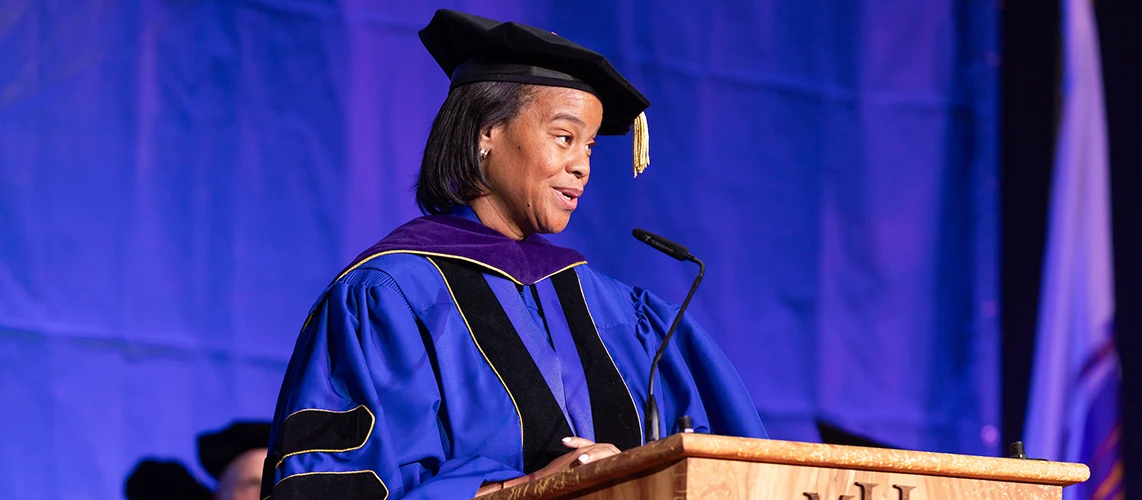
Mount Holyoke College President Danielle R. Holley addressed the graduates at the College’s one hundred eighty-ninth Commencement ceremony.
Good morning, class of 2026, Frances Perkins scholars, certificate recipients, master’s degree students, honored guests, families and friends! It is my honor and privilege to welcome you to our one hundred eighty-ninth Commencement ceremony.
This is the day you’ve been waiting for. The culmination of the work you’ve poured into earning your degree. The celebration of the person you have become within our gates.
You arrived on campus [as] strangers, bringing hundreds of different perspectives and experiences, and you became a community.
Today, you join another group — over 40,000 strong, spanning 137 countries and 80 classes — the proudly gender-diverse Mount Holyoke alum network.
What unites Mount Holyoke grads across both geographical borders and generations is the shared understanding that growth is a process. It’s never finished. And it happens by never ceasing to question.
In 1903 (just one year before Professor Kinney planted the copper beech), the Austrian poet Rainer Maria Rilke wrote:
Be patient toward all that is unsolved in your heart and try to love the questions themselves, like locked rooms and like books that are now written in a very foreign tongue. Do not now seek the answers, which cannot be given you because you would not be able to live them. And the point is, to live everything. Live the questions now. Perhaps you will then gradually, without noticing it, live along some distant day into the answer.
Rilke challenges us to become comfortable with all we do not know and to accept that knowledge comes from inquiry, introspection, and lived experience. We grow and change by cultivating curiosity and by engaging with a community of collaborators to formulate harder, broader, and deeper questions. And through that process, over time, we achieve wisdom.
Indeed, when you came to Mount Holyoke, you moved from the child’s practice of seeking answers to the scholar’s method of contemplating problems. Shepherding you along this path was a faculty for whom asking questions is life; a curriculum that blurs the boundaries between art and science in ways that reinforce the nuanced nature of the problems we face; and a community that defies both easy answers and easy binaries in its search for truth.
Now, poised to begin your next adventure, you may find yourself preoccupied by answers, or, more specifically, by a lack thereof. It’s true: none of us knows precisely what the future holds — particularly at this moment when the world seems to have gone mad. This can be nerve-wracking. My advice: don’t let impatience for the answer distract you from living the question. You have honed your intellectual skills. You’ve identified personal values. You have built community. You know how to examine systems of power, draw connections and articulate the unsaid. You have attained wisdom that puts you in good stead to ask the next round of questions.
For today, absolutely, bask in the answer: Will I succeed in college? Will I make friends? Will I graduate? Friends, that answer is a resounding YES! Enjoy this moment that you spent years working toward.
But tomorrow — tomorrow, wake up, and start asking questions again. We’re counting on you!