
Life Lines: art, memory, relationship
Mount Holyoke Professor of Anthropology Joshua Hotaka Roth has a new graphic memoir, “Life Lines,” about his father’s life and art. In this essay, he discusses the contrast of care for the elderly between the U.S. and Japan.
For several decades in mid-life Dad worked in obscurity, producing his abstract expressionist paintings between midnight and 2 am on our living room floor of our apartment in Queens, working odd jobs as substitute math teacher, taxi driver, messenger for a law firm and word processor to make a living. When he reached 90, I suggested we work together on a graphic memoir about his life and art. I joked that this would bring him the fame and recognition he had not been able to achieve for himself. By that time, cataracts had clouded his vision and a tremor in his right had made it hard to draw a steady line and he’d given up making art, but he was a willing collaborator when I pulled out his old sketchbooks to talk about what he had been doing. It was in these books that he’d developed five different syllabaries with which he could write messages into his abstract paintings that nobody but he could decipher. In our project we explore some of the motivation for his creative work, and what may be better expressed in opaque images rather than in more transparent words. But we almost weren’t even able to start our project.
Dad was recuperating from partial hip replacement in a rehab facility when he got sick with a fever one night, had become unresponsive and had to be rushed to the ER early in the morning. It was only when one of the ER doctors administered Narcan, the opiod rescue drug, that Dad revived. It was a shocking introduction to the world of elder care in the U.S.
Facing a rapidly aging society, Japanese lawmakers in 1997 passed Long Term Care Insurance that would help pay for critical care services for those living in their own homes, as well as in senior group homes, and in nursing facilities, based on the level of need, regardless of income level. The country with the largest proportion of the population over 65 years of age, Japan represents the future for many other countries that are contending with low birth rates. Meanwhile, in the United States, the lobby for corporations running most nursing homes has successfully killed legislation that would have ensured minimum guidelines for the number of caregivers and nurse practitioners per resident and other regulations meant to prevent neglect and the overreliance on psychopharmaceuticals to sedate patients in chronically understaffed institutions (Vogel and Jewett, 2026).
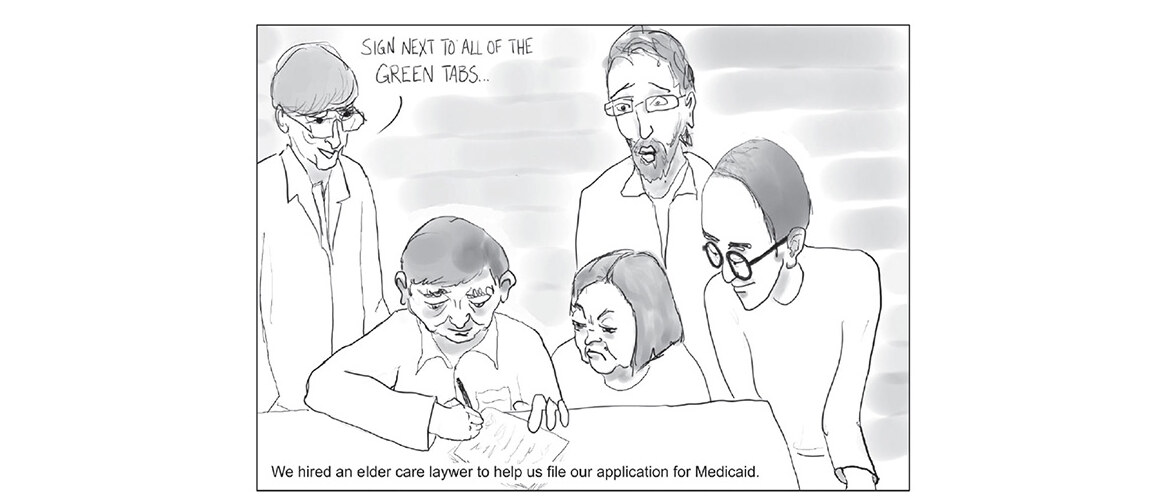
The authors of the Care Manifesto write that “if the neoliberal defunding and undermining of care has led to paranoid and chauvinist caring imaginaries — looking after ‘our own’ — adequate resources, time and labour would make people feel secure enough to care for, about and with strangers as much as kin” (Chatzidakis et al. 2020, 42). Luckily, my parents were living in New York state, where the look back period for bank statements for Medicaid qualification was three months (as opposed to five years for nursing home care) and we were able to work the system in order to qualify for support before burning through their entire savings. But why can’t we just have a system that works to cover basic services for everyone, as in Japan, without forcing individuals to work the system, and even then, only those who are lucky enough to live in the right state and have the necessary knowledge or connections?
Dad recovered, allowing him and me to collaborate on Life Lines, our intimate ethnographic work about his life and his art, which became also a work about aging and caregiving. While caregiving necessarily involves focus on health and safety, and negotiating health care bureaucracies, I discovered that our collaborative project was the best form of care that I could provide, for it engaged my dad in something that was meaningful for him. At the same time, I was a beneficiary. It made me into a graphic novelist. It allowed me to recognize the generative possibilities within the burden of care for others in advanced old age. Life Lines is an account of one small effort to create a caring community within a sea of carelessness. It is also a mystery, whereby I attempt to decipher the hidden messages and motivation behind my Dad’s artistic production.
Notes:
Chatzidakis, Andreas, Jamie Hakim, Jo Littler, Catherine Rottenberg, and Lynne Segal. 2020. “Caring Kinships.” In The Care Manifesto: The Politics of Interdependence. London: Verso.
Kenneth P. Vogel and Christina Jewett. 2026. “After Donations, Trump Administration Revoked Rule Requiring More Nursing Home Staff,” The New York Times (January 27).