
Betty Ann Allen ’72 and Emilyann Nault ’19
Elizabeth (“Betty Ann”) Allen ’72 and Emilyann Nault ’19 share how Mount Holyoke College, internships and other experiential learning opportunities prepared them for career success. Emilyann serves as programme manager for the Movement and Rehabilitation (MoveR) Digital Health and Care Hub at the University of Edinburgh, Scotland. Betty Ann was a petroleum geologist for Shell Oil. A former trustee and faculty member of Mount Holyoke, Betty Ann is an ardent supporter of internships and a member of the Mary Lyon Society.
When you first started at Mount Holyoke, how did you envision life after college?
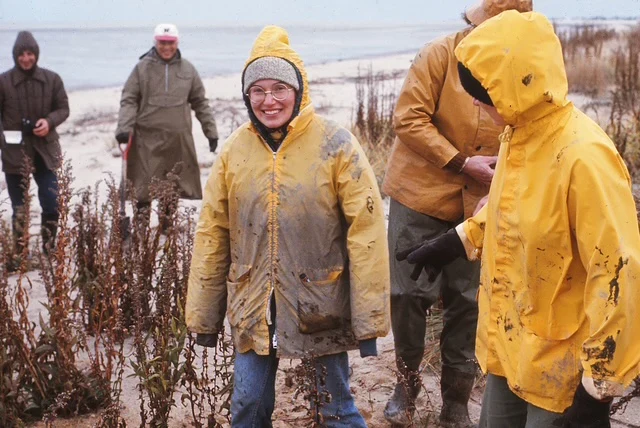
Betty Ann Allen ’72: When I was in high school, I was told to stay away from science because I was a girl. When I got to Mount Holyoke, I was so excited to nurture my love of learning and take all different types of courses. I took geology to fulfill my science requirement. It fit into my schedule, and I just fell in love with it.
Emilyann Nault ’19: I was interested in STEM. I wanted to be a doctor or a surgeon or something like that. Outside of that, I was just ready to explore and see what else was out there. I like to think of Mount Holyoke as a funnel. Because it’s liberal arts, you can ping-pong around a bunch of different things until you funnel into what gives you passion and purpose in life.
Describe a moment when you had a shift in your thinking about your future.
Betty Ann: I had two summers of funding from the National Science Foundation, where I was able to do my own research alongside geology professors and students from Williams, Amherst, Smith and Mount Holyoke. This reinforced my love of geology and research, and it exposed me to other geologists. The turning point was when an Amherst graduate told me, “Remember, you can have an interesting career in industry or government, as well as in education.” And so, that seed was planted. When I was in graduate school in the mid-1970s, during the Arab oil embargo, I decided I was going to work for one of those big bad oil companies and see what it was really like. And that totally changed my life. It took me all over the world, all because of that one casual conversation with my colleague.
Emilyann: In my sophomore year, I volunteered at Spaulding Rehabilitation Hospital (Boston) in the assistive technology clinic. I saw how the technology the therapists had could be personalized for quadriplegic and paraplegic patients to give them more independence and allow them to communicate better. It showed me how technology can enhance people’s lives, even at the worst points in their lives.
Emilyann, tell us about the internship you did at Heriot-Watt University, where you went on to earn your Ph.D. How were you drawn to that internship, and how did Mount Holyoke prepare you for success?
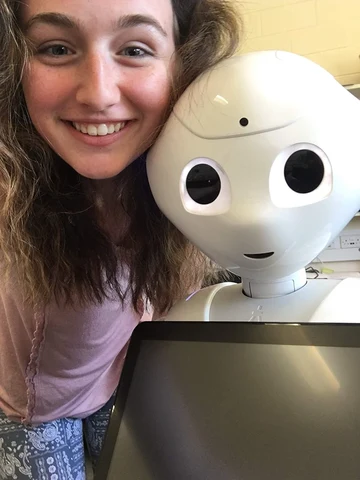
Emilyann: After Spaulding Rehab, I knew I wanted to be in digital health. The Career Development Center sponsored an event in Hooker Auditorium, and I saw a booth for the McCulloch Center for Global Initiatives. I was always curious about studying abroad. So I told the McCulloch staff person that I wanted to do academic research in digital health in an English-speaking country. I could tell that he had no idea what to do with me! But he spoke with his colleague, who knew someone at Heriot-Watt who knew someone else at Heriot-Watt, who ended up becoming my internship and Ph.D. supervisor. Passing that booth in Hooker Auditorium led to my life shifting to Scotland.
What is something that you learned about yourself through your research?
Betty Ann: I learned I was fearless. I went into a male-dominated profession, a tough physical profession, but I was so passionate about it that I never stopped, even when I was asked, “What are you doing here? You’re taking the place of a man.” I didn’t let it bother me because I loved what I was doing.
Emilyann: Yes, Betty Ann. Mount Holyoke gave me that extra ease and support to feel more comfortable pursuing the computer science side of my field, which is also quite male-dominated. I wasn’t as naturally inclined to the technical skill of coding, but at Mount Holyoke, I could ask questions whenever I wanted. The all-women environment made a big difference for me.
Betty Ann: Emilyann, I agree with you completely because I know that if I had gone to a co-ed school, I wouldn’t have majored in geology. At Mount Holyoke, just seeing so many smart women doing exceptional things, being around people like that all the time, it became part of you. You just went and did it.
Describe someone from your time at Mount Holyoke who impacted your professional career, and their importance to you.
Emilyann: Ryan Lewis, then the fellowships director at Mount Holyoke, helped me prepare for an interview for the Saint Andrew’s Society Scholarship. He worked with me to clearly articulate my passion for digital health. The other person was my roommate, Courtney Hegner ’19. Her Mount Holyoke degree is in biochemistry, and now she’s studying for a Ph.D. in immunology. Courtney was up at six every morning to feed her cells, while I had my duvet over my head. It’s amazing to see her flourish in her way, and me flourish in another direction.
Betty Ann: I stayed in touch with several professors as friends and colleagues. Marty Godchaux was a role model as a woman geology professor. I also took courses in biology and ecology from Tibby Sprague, where there was so much taught about coastal resilience that I still use today. I also took an urban studies course with Peter Enggass of the geography department. He took us into immigrant communities in Holyoke and helped us to consider the connections between civil rights and environmental issues. His course also gave me a greater appreciation for Frances Perkins’ championing of working-class people, and I later became a founding member of the Frances Perkins Center in Newcastle, Maine.
Tell me about a challenge that you encountered at some point in your career. How did your Mount Holyoke education help you through it?
Betty Ann: Throughout my life, my Mount Holyoke friends have been there for me. In 2011, I was diagnosed with a brain tumor and had surgery. My Mount Holyoke friends were by my side 24-7. I survived because of them; I can’t say enough about the sisterhood that we have.
Emilyann: COVID-19 was a challenge. I started my Ph.D. in September 2019. My research was on human–robot interactions, and I had no access to humans for a while. That innate perseverance that we have as Mount Holyoke alums helped. When it was permissible, I held a study in the parking lot of the university. The robots were not meant to be outdoor robots, so we set up a giant tent to block out the Scottish rain and wind! The older adults in my study were thrilled to be there because social engagements were limited at that time. They stuck with me through the rest of my Ph.D. research.
Please share about what inspires you to support internships at Mount Holyoke.
Betty Ann: I had those two internships as an undergraduate, and they were pivotal. I loved studying geology out of a book, but then I realized that I also loved doing it, and so I wanted to open the door for others. I set up an internship fund in geology at Mount Holyoke, and I also set up one in my son’s field. He was a film studies graduate student at UCLA. But the film studies program at Mount Holyoke is absolutely fabulous, so I was happy to support that program.
Emilyann: The staff at Mount Holyoke put in effort that completely changed my life’s trajectory, and that meant a lot to me. I try to give back in ways that I can, like by doing this interview and being on panels hosted by the Career Development Center.
Our mission at Mount Holyoke is to give students the tools to become purposeful leaders in a culturally diverse world. How did Mount Holyoke prepare you to be a purposeful leader?
Emilyann: I’ll reiterate that Mount Holyoke allowed me to explore my field in a way that I wouldn't have been able to in a co-ed environment. It’s not just about the academic context. I remember meeting alums who worked at Google and who were in roles that I was thinking of working toward. And building those soft skills through all of these experiences I had over the years, being able to engage with people in different fields… Everything we do at Mount Holyoke is interdisciplinary. You can study anything you want and merge ideas together. That baseline really helped me later run and manage interdisciplinary research projects.
Betty Ann: When I was a young child, I saw a lot of inequity in the world — social, racial, gender — and it made me mad! So, when it came to choosing a college, I was really drawn to Mount Holyoke because I saw a caring community that was working on these issues, and where women from all socioeconomic backgrounds had access to education. That inspired me.
The Mary Lyon Society is made up of individuals who are actively working to strengthen Mount Holyoke's future. What hopes do you have for that future?
Betty Ann: Academic excellence is the most important thing. If we lose academic excellence, then nothing else that we strive for is going to happen. I think the school is doing a very good job.
Emilyann: I agree. It’s the academic excellence and the close relationships with the professors. I could not imagine going to college in lecture halls of three hundred people and trying to have a voice and a name in those big rooms. The other thing for me, personally, was the Lynk internship funding and having that extra cash to get me to Scotland. I appreciate seeing how Mount Holyoke has grown and made opportunities broader while maintaining the importance of women’s education. Basically, I’d tell the College, keep doing what you’re doing.