
Mount Holyoke’s rare mathematical models on display
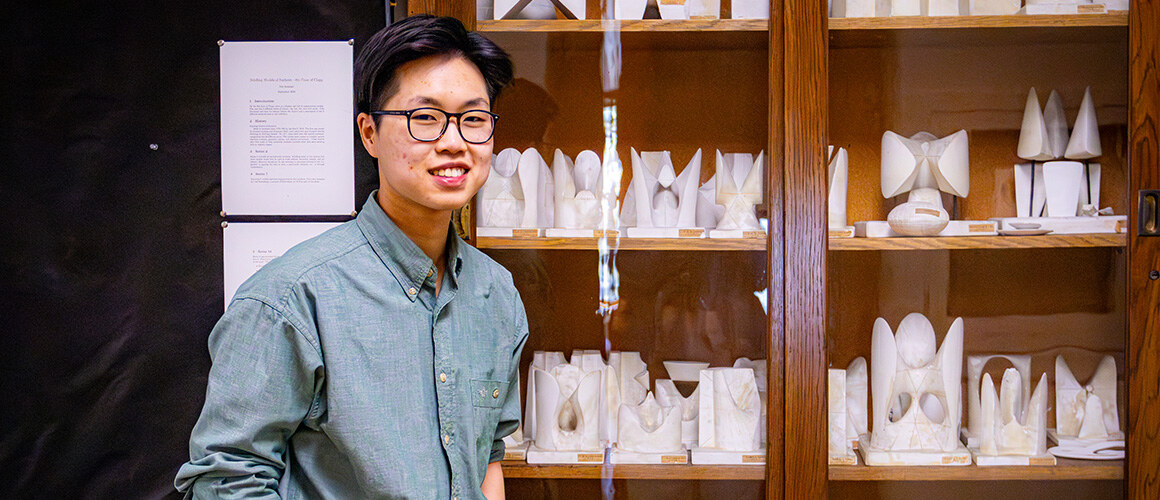
Hanh M. Pham ’26, a senior at Mount Holyoke College, reports on nineteenth-century mathematical models now on display on campus.
When I first heard about a set of nineteenth-century mathematical models sitting in the Mount Holyoke College Department of Mathematics and Statistics, I was immediately intrigued.
The models were produced between the 1870s and 1932 by the publishing house of Martin Schilling, based on designs developed at the Technical University of Munich under mathematicians Alexander von Brill and Felix Klein. Handcrafted in plaster, silk thread and brass, the models were distributed to many universities worldwide as tools for visualizing abstract mathematical surfaces. Surviving sets are held by a small number of institutions, including the Smithsonian Institution, Dresden University of Technology, and Oxford University. To find 55 of them at a small liberal arts college is, by any measure, remarkable.
The work of identifying the models was not straightforward. Some arrived with labels; others did not. I cross-referenced the objects against records from other institutional collections, as well as primary sources — the most useful of which was the original “Catalog mathematischer Modelle,” a German catalog published by Schilling. Its 1911 edition documented 377 models across 40 series. Where relevant sources existed only in German, I translated them. Each model was then cataloged and photographed from multiple angles.
At their peak, these models were housed in many major research universities around the world. They were the standard way mathematicians visualized surfaces before computers existed. They also carry an unexpected artistic legacy. In 1934, Man Ray photographed a similar collection in Paris, and the images were published in “Cahiers d’Art” alongside an essay by André Breton. Henry Moore, Barbara Hepworth, and Naum Gabo each drew on the models for their own work in the years that followed. More recently, photographer Hiroshi Sugimoto produced monumental aluminum sculptures based on their forms.
A collection this historically layered is worth making visible. Several models are now on display in Kendade Hall, first floor. The full collection is held in Clapp Laboratory, fourth floor.