
A student teacher attends to her own learning
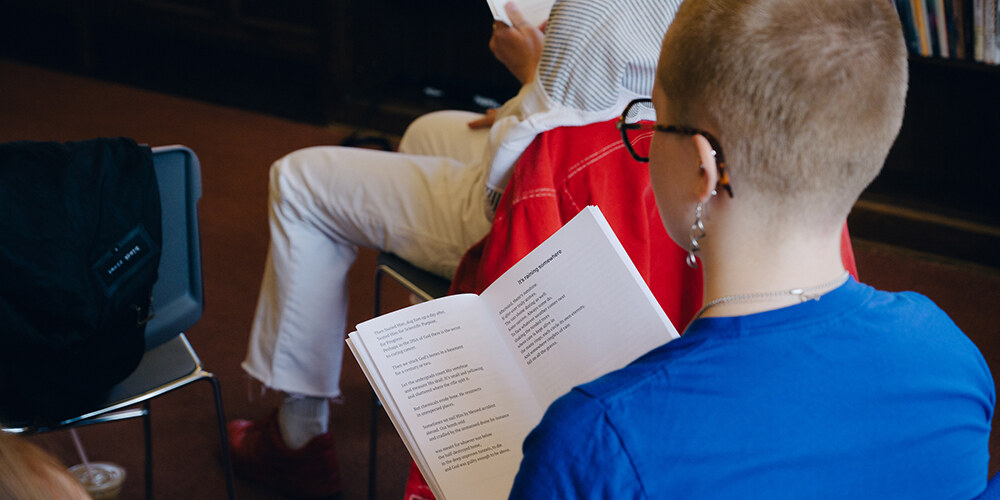
Mount Holyoke College senior Cora Elena Harte ’26 was student teaching in Amherst, Massachusetts, this semester as part of her teaching licensure. She attended two conferences on reading and literacy to help both her current and future students.
As a senior in the teacher licensure program, I am required to participate in professional development experiences throughout my final semester. There are some core guidelines, but overall there is a lot of flexibility, and students have opportunities to participate in different professional development experiences. Mount Holyoke College received funding from a Massachusetts Department of Elementary and Secondary Education grant that has allowed students to attend various workshops and conferences. Because of this amazing grant, I was able to participate in both the Pioneer Valley Early Literacy Consortium 2026 Research-to-Practice Literacy Conference in Northampton, Massachusetts, and the Massachusetts Reading Association Fifty-Fifth Annual Conference in Newton, Massachusetts, this past March and April.
I arrived at the Campus School of Smith College in Northampton around 7:15 am on March 29, where I was warmly greeted and invited into the gym for a quick breakfast among local educators. Then I headed to my first session. I chose one on storytelling and was able to see how teachers had utilized readers theater and other forms of storytelling in their classrooms to create a really strong foundation for reading and writing.
I then attended a session led by Jillayne Flanders and Gwen Agna, two former principals from schools in Western Massachusetts who have each dedicated their retirement to promoting diversity in literature. Agna has written beautiful children’s books — “True You: A Gender Journey,” “Finding Home: Words From Kids Seeking Sanctuary” and “Community-Centered School Leadership: Lessons in Sustaining a Just and Equitable School” — that center real experiences with immigration and gender, often incorporating photographs of children so readers can more deeply connect the story to the individual. Flanders has coauthored multiple books — such as “Little Learners, Big Hearts: A Teacher’s Guide to Nurturing Empathy and Equity in Early Childhood” and “Advancing Empathy and Equity in Early Childhood Education: The Leader’s Guide to ‘Little Learners, Big Hearts’” — that serve as guides for teachers looking to build equity in their classrooms through diverse texts.
In many of my education classes at Mount Holyoke, we discussed how teachers often have multicultural and diverse books available but don’t fully engage with them because of a lack of confidence or knowledge. I strongly believe simply having a diverse classroom library is not enough. It is essential to intentionally teach and discuss these topics with students from a young age. I was incredibly grateful to learn from two experienced and respected educators who shared tangible, practical ways to create classrooms that foster inclusivity and equity, with literature as a central force.
On April 8, at 5:30 pm, another senior from the licensure program and I left South Hadley, Massachusetts, had dinner, drove to Newton for the Massachusetts Reading Association’s conference and settled in early for the next day. The next morning, we were up early, and after grabbing a quick coffee, we made our way to the first session, “The Gift of Story,” with John Schu. Schu talked about why books and stories were important to him, what led him to become a teacher and how he turned his love for stories and books into a career as a nationally recognized librarian and author.
Throughout his presentation, Schu gave away books that he had bought himself. He scratched way below the surface while explaining why having access to books that create a place to escape and reflect experiences a reader is going through is so important. Oftentimes, it may be a reader’s way to cope with whatever may be going on in their lives. Schu’s presentation reinforced the importance of Rudine Sims Bishop’s framework of mirrors (reflect readers’ own lives), windows (views into different worlds) and sliding glass doors (readers get to step into another world, fostering empathy and deep connection).
Using his own lived experiences as a teen, he lauded the importance of books that helped him escape and that he wrote the books that he wished he had when he was struggling. What was most amazing about Schu’s presentation was his passion. In my opinion, one of the most beautiful things a person can witness is someone being able to be openly passionate about something they love. Watching Schu share his love of books, poetry and creativity was invigorating because he was so authentically interested and invested in what he was talking about.
After Schu’s presentation, I attended a smaller session led by Kimberly Hollock on creating literacy partnerships with parents. In this session, we discussed how parents often feel helpless when supporting their children because of a lack of confidence with academic content. Hollock emphasized the importance of prioritizing two-way communication in which teachers actively center parent input and feedback. She also highlighted the value of establishing at-home literacy practices, ensuring that parents understand both how to engage in activities and what skills those activities are designed to strengthen, rather than simply sending students home with a literacy game.
I ended my day by attending a speech by Carmen Agra Deedy, this year’s MRA Children’s Literature Award recipient. Deedy, an author and storyteller, quickly drew us in with a personal story about getting in trouble at school. She described how her principal chose a punishment that, while still a consequence, didn’t diminish Deedy’s ability to be a risk-taker. Years later, Deedy reconnected with her principal and asked why she had chosen that approach rather than a harsher punishment. The principal explained that she had often seen children with great imagination and a willingness to take risks be punished for those traits at school to the point that it became limiting and that she didn’t want that spark to be diminished in Deedy.
I was deeply moved by what Deedy shared. That evening, I found myself reflecting on the power and influence I will hold as an educator. I thought about how my mindset and beliefs about a student’s success can directly shape their experience and growth, something we have discussed extensively in education classes that I have been in. Sitting with Deedy’s experience reinforced for me that being intentional, reflective and mindful are not just ideals but core values I will need to actively live out in my daily practice.
The next day, I was in my seat, ready to take in whatever Molly Ness had to throw at me. Ness started by taking us through her experience of starting to read a book she had finished last summer. She modeled how she stumbled upon the word “slough” (wet, marsh area, bog) and got stuck. I confidently thought to myself that the word is obviously pronounced like “s/l/au.” I was wrong — the word is actually pronounced like “s/l/ew.”
From there, Ness began to unpack how our brains map words into long-term memory. When we encounter a word, our brains draw on knowledge of letter-sound relationships and our understanding of phonemes to segment and blend the word. With repeated exposure, the brain maps the word into long-term memory, eventually allowing it to become a sight word. This process is known as orthographic mapping.
On average, adults have between 30,000 and 70,000 words stored as sight words. These are not words we have memorized in isolation but instead are words that have been securely stored through orthographic mapping. In fact, most of the words you are reading right now are likely words you have already orthographically mapped.
Why is this so important?
There is a significant gap in how often instructional strategies explicitly support orthographic mapping during early reading development. For reading to be considered fluent, the majority of words a student encounters should be instantly recognized rather than sounded out. This allows readers to focus on meaning and comprehension rather than on decoding each individual word on the page. Ness made a compelling case for prioritizing early literacy instruction that actively supports orthographic mapping, ultimately leading to stronger reading fluency. This can be achieved by emphasizing practices that help students store words in long-term memory.
While Ness was a tough act to follow, Gravity Goldberg was more than up to the task. Goldberg spoke about how learning is an inherently physical process, emphasizing the powerful role of the mind-body connection in classroom instruction and student engagement. While the research she presented was fascinating, what stood out most were the practical strategies she models in her own classroom and invited us to try during the session.
This semester, I was student teaching in a third-grade classroom in Amherst. My students already practice mindfulness as a way to transition back from recess and lunch, but there are many other moments throughout the day when they become dysregulated or distracted. Goldberg provided a variety of simple, accessible strategies that I was able to implement the very next Monday, creating short opportunities for students to reset and return to learning in a more focused state. While these strategies are not a magic fix and didn’t work for every student, I noticed a significant difference when incorporating several of the techniques she had shared.
While both conferences had very different vibes, presenters and overall experiences, I walked away from each with a very similar conclusion. We are in a scary and uncertain time. Education has become far more controversial than it ever should be, and much of it feels like it is under attack.
And yet, I left both conferences feeling a strong sense of hope. That hope came from the people: presenters who clearly care deeply about their work and the impact they have and educators who showed up ready to be there and fully engage with every topic. Being surrounded by so many passionate, committed individuals was a powerful reminder that, even in challenging times, there is still so much dedication and purpose driving this work forward.