
Students driving discovery in neuroscience research
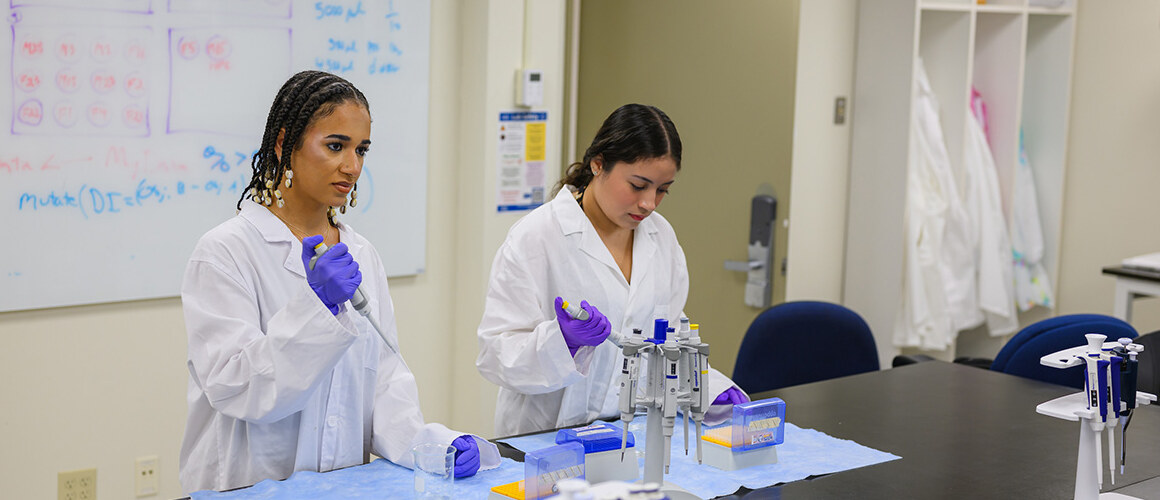
Jared Schwartzer, professor of psychology and education at Mount Holyoke College, discusses neuroscience research on campus and which students will likely succeed in his lab. (Hint: It’s not necessarily just students majoring in a science program.)
On any given morning in my lab, students calibrate lighting, frame cameras and carefully mark mice with pet-safe pigment so they can track each animal precisely. It does not look like the neuroscience most people imagine, and that misconception is exactly what my students and I spend our time dismantling.
The work we do is methodical, data-driven and high-stakes. Undergraduates, many of whom arrive simply for a campus job and believe they are not scientists, carry out this work almost entirely. My lab sits at the intersection of two realities: rigorous biomedical research and the deliberate training of students still discovering their potential.
Students tackle a simple but consequential question: How does maternal allergic asthma during pregnancy affect the developing brain, social behavior and long-term mental health of the offspring? In a world increasingly shaped by air pollution, viruses and complex chemical exposures, this research examines how a mother’s immune response can shape her children’s developmental trajectories. The National Institutes of Health, the U.S. National Science Foundation and the Beckman Foundation have supported my work, contributing funds that enable undergraduates to participate directly in federally and foundation-funded biomedical research.
We train the students we recruit, so I do not look for polished résumés, technical expertise or prior research experience. There is no written exam to test their neuroscience knowledge. I am most interested in students whose potential has not yet been recognized, including by themselves sometimes. What matters is resilience, curiosity and openness to feedback. I value students who can move through setbacks without shutting down, who understand that competence develops through critique and revision and who are willing to say, clearly and without embarrassment, “I don’t know,” and then ask the next question. When a student tells me, “I’m not a scientist,” I often find myself thinking — not yet.
Students do not need technical expertise when they join. We train everything on the job. Much of experimental science relies on careful repetition and attention to detail. When I was in college, I believed that science required rare talent, something closer to virtuosity than practice. I only later realized, after performing basic lab tasks, how much of science relies on performing the same procedures again and again to generate reliable data. Science is not magic; it’s persistence.
We use animal models to study how prenatal environments shape behavior. During the research, students breed mice, alter maternal environments during pregnancy and monitor the offspring over time. We have studied the impacts of air pollution, electronic cigarettes and allergens during gestation and the consequences they have on developing offspring. One central behavioral assay focuses on social interaction. Students place two mice that have never met into a testing arena and record their interactions. It is a structured version of a first encounter that captures how animals approach, retreat, engage and adapt.
The task is deceptively difficult. The mice are visually identical, and tracking individuals is challenging when they move quickly and interact closely. Several former students developed a simple but effective solution: using animal-safe grooming pigment to mark each mouse with a different color. The approach was so successful that we were able to integrate computer-vision tracking for precise, unbiased behavioral analysis.
Lab culture matters deeply. In my lab, we operate as a team without ego or seniority, and every member is accountable. Many of our experiments are longitudinal, so errors can have lasting consequences. We emphasize communication and ownership from the start, and students are expected to say if they are unsure about a procedure. A mistake does not become a failure if it is addressed in time, and trust and transparency are central to maintaining rigor and integrity.
Over the years, I have watched students arrive expecting to stay for just one semester. Instead, they leave after two or more years as coauthors of peer-reviewed papers, award-winning presenters and future Ph.D. scholars. One international student, an economics major with limited prior experience in neuroscience, joined simply for a summer job. She stayed for three years, completed a senior thesis, coauthored a publication, won a conference award and helped launch a new lab. Another student, a talented artist, fell in love with neuroscience without abandoning her creative practice. She now works at the intersection of art and science, translating complex ideas about the brain for broader audiences.
Not every student who joins my lab becomes a scientist, and that has never been the metric that matters most. What matters is that every student leaves with the ability to think independently, question assumptions, collaborate effectively and work with care in the face of uncertainty. Those habits endure and surface in graduate and medical training, public health, policy and the creative fields, where evidence, judgment and accountability shape decisions.
In my lab, undergraduate research is not an enrichment activity; it is the engine of discovery. Students generate data, solve problems, refine methods and contribute meaningfully to questions with real public health relevance. This is what research looks like when access and rigor are treated as inseparable.