Three days that changed how I see myself in Mathematics
Mount Holyoke College student Anita Chiragia ’28 reflects on how presenting her research at her first mathematics conference helped her build confidence, explore new career possibilities and find a sense of belonging in the field.
Before attending my first mathematics conference, I was nervous. I did not know what to expect and thought it would be intimidating. However, it ended up being the most welcoming experiences I had ever had.
I traveled from South Hadley to Winston-Salem, North Carolina, to attend the National Association of Mathematicians Undergraduate MATHFest at Winston-Salem State University (WSSU). Three days later, I returned with new ideas, new friends and a feeling I couldn’t quite describe: a sense of belonging and excitement.
It’s remarkable how much these three days influenced my plans for the future.
The National Association of Mathematicians (NAM) has supported underrepresented groups in mathematics for more than 50 years. Its MATHFest conference has been held since 1991.
Hosted at Historically Black Colleges and Universities (HBCUs), the conference brings together mathematics enthusiasts, from high school students to professors. The event aims to help students feel supported in their math communities and see themselves as mathematicians.
I believe it achieved that goal because I felt heard, seen and supported.
Day One
The first day of the conference started with an afternoon tour of WSSU’s campus, where we learned about its history. Following the tour, we had refreshments and listened to a lecture by Kimberly Sellers, head of the statistics department at North Carolina State University. Her talk, “Take Count of Dispersion,” introduced the Conway-Maxwell-Poisson model, a flexible approach for studying count data.
I also learned about J. Ernest Wilkins Jr., a famous mathematician and engineer who had attended MATHFest and earned his PhD at just 19.
Day Two
The second day was the busiest, filled with student research talks and poster presentations. I attended sessions on rainbow arithmetic progression, knot invariants and frailty in African American adults with and without diabetes.
Listening to students present their work was a wonderful experience. I learned about research topics I hadn’t encountered before, which exposed me to different ways mathematics can be used to solve problems. One presentation I found particularly interesting examined how lockdown changed posting patterns on Twitter.
Presenting my research
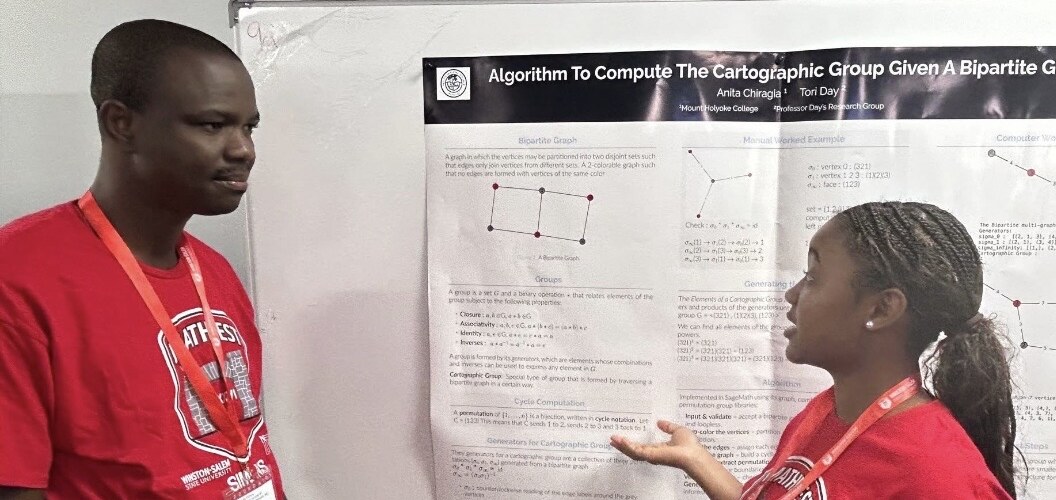
When it was my turn to present, I felt nervous and shy. My poster, “Algorithm to Construct the Cartographic Group Given a Bipartite Graph,” transformed a picture into algebra. It was fun to see how much detail is hidden in bipartite graphs.
As I began presenting, I grew more confident because I realized how much I had learned. I was amazed to see people listening to my presentation, following along, understanding my work and even offering their insights.
A major reason I felt prepared was the practice sessions I had with Professor Tori Day from Mount Holyoke’s Department of Mathematics and Statistics. My previous presentations at Math Lunch and the Science Center Symposium at Mount Holyoke also helped build my confidence.
In the afternoon, I attended a graduate student panel exclusively for students. The panel included students pursuing master’s degrees and doctorates at various universities. They shared honest insights about research and what to expect from graduate school.
After the panel, I attended the exhibition fair where representatives from graduate programs, summer research programs, fellowships and employers had set up booths. I learned about several career paths available in mathematics that I had not previously considered
I spoke with a representative from the Society of Actuaries and was introduced to actuarial science, a career path that immediately caught my attention. It seems interesting and within reach, despite the numerous exams required to become an actuarial fellow.
Between sessions I participated in Problem Time, led by Samuel Ivy and Duane Cooper. Problem Time was like a puzzle competition featuring challenging math problems. We were given problems to solve, and the first person to find an answer and explain it to everyone won a prize. Prizes included gift cards from Walmart, Amazon, Target, Starbucks and other stores.
I particularly enjoyed these sessions because they gave me and opportunity to make friends while challenging myself to solve problems!
Finding a sense of belonging
What surprised me most about the conference was how welcoming everyone was. People were friendly and easy to talk to, and it was refreshing to meet mathematicians of color who encouraged my growth and wanted to see me succeed.
The conference helped me realize that there's a community of mathematics enthusiasts who share my curiosity and excitement for the subject.
I think every mathematics major should attend at least one conference, especially if they've ever felt that they don't belong in mathematics.
If you're planning to attend a conference, here are a few things that helped me make the most of my experience:
- Plan ahead. Review the conference program and create a schedule, since many sessions may happen at the same time.
- Take notes. Bring a notebook and pen to record insights, names, email addresses and ideas you want to explore later.
- Connect with others. Talk to people, make new friends and stay in touch through LinkedIn or other social media platforms.
I would like to express my sincere thanks to Professor Tori Day, my research adviser, Connell Heady and the Department of Mathematics and Statistics department for funding my trip. I am extremely grateful for their support. Without them, I would not have had this opportunity.