Dylan Shepardson

  • Robert L. Rooke Associate Professor of Mathematics
  • Nexus Track Chair for Data Analytics & Society
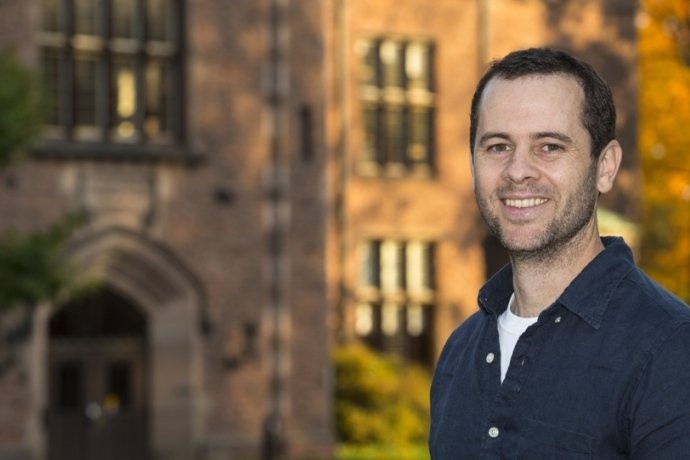
Dylan Shepardson

Dylan Shepardson works on mathematical problems that are motivated by applications in other disciplines, like biology, epidemiology, sociology, or archaeology. He is especially interested in new and unusual applications of optimization theory. In most physical, biological, and economic systems, a property is being optimized (like energy or entropy in physical systems, or reproductive success in evolutionary biology), and optimization techniques offer interesting insights into these systems. Shepardson's recent projects include voting theory and its connections to combinatorial geometry, infectious disease modeling, and the problem of using collections of radiocarbon data to estimate dates of the earliest human settlements of Pacific islands.

Education

  • Ph.D., Georgia Institute of Technology
  • M.A., University of California - Berkeley
  • B.A., Amherst College

HAPPENING AT MOUNT HOLYOKE

Recent Campus News

Mount Holyoke College President Danielle R. Holley defended the liberal arts in an interview with the Boston Globe Magazine, warning that a deep education deficit threatens civic empowerment and leaves people vulnerable to misinformation.

Second Nature reported on Mount Holyoke College’s Community Commitment to Climate Justice, a grassroots initiative that empowers students and staff to cocreate equitable sustainability solutions.

Chicago Mayor Johnson's ambitious social housing agenda faces a steep climb. Mount Holyoke Class of 1926 Professor of Politics Preston H. Smith II analyzes the political traps and developer interests threatening the city's progressive housing vision.

Recent Grants

Margaret Robinson PI with Co-PIs Giuliana Davidoff, Dylan Shepardson and Jessica Sidman (Mathematics) received a grant from the National Science Foundation (NSF) for “Collaborative Proposal: Hudson River Undergraduate Mathematics Conference 2020-2022” – with Keene and Siena Colleges. The project is for three years.

View More