
MHC students attend the IMPACT National Conference
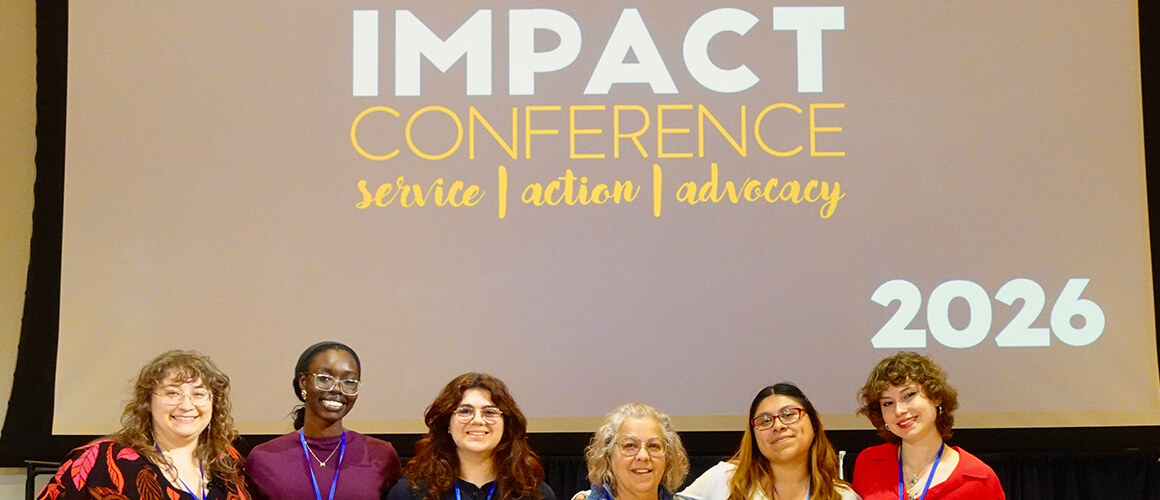
Mount Holyoke College students Madeline Greenberg ’26 and Sarah Dziekan ’27 attended the 2026 IMPACT National Conference as part of their involvement in Community-Based Learning.
The Community-Based Learning (CBL) program at the Weissman Center for Leadership provides students with the opportunity to build sustainable, reciprocal and transformative relationships with Mount Holyoke College’s surrounding communities and community partners.
The director, Maria Cartagena, is an activist, community advocate and a strong voice for the community in Western Massachusetts. As the director of CBL and someone who has been a community partner herself, she brings a valuable perspective to both the program and the College. She is a mentor who brings students’ voices to the forefront of the conversation, and each and every student who has interacted with her can say that she has advocated for them. We both have incredibly fond memories of how Maria and the rest of CBL brought us in and made us feel welcomed and supported. It was through the efforts of CBL that our group of four students had the opportunity to attend the 2026 IMPACT National Conference in Cincinnati, Ohio, this February. We each had unique, transformative experiences that will shape the future of our leadership and inform the community engagement work we will do.
The IMPACT Conference is an annual gathering focused on bringing civic and community-engaged college students together with the shared values of service, action and advocacy.
Sarah was deeply inspired by what was learned at the IMPACT Conference, but one session that stuck out in particular was a panel titled “Service Learning and the Parable of the Three Blind Men and the Elephant.” In this parable, three blind men individually touch three distinct parts of an elephant but are unable to identify the animal. It is only when all three men’s perspectives are brought together that the elephant can be identified. Community engagement operates similarly; each individual participating in a relationship has strengths and weaknesses, and our own privileges and perspectives come together to create a whole picture. Despite this, our different positionalities can prohibit us from building relationships with our communities, especially if we do not allow community members into decision-making. Everyone deserves a seat at the table — to influence and have a say in the work we do in collaboration with them.
One topic of discussion stuck out in particular: “Did you come to teach, or did you come to learn?” This is incredibly relevant to the core philosophy of CBL. A vital aspect of community engagement is allowing relationships to go both ways; we have just as much to learn from our communities as they have to learn from us. CBL taught Sarah about our responsibility as a higher education institution to give back locally and to create these reciprocal relationships of learning between the surrounding communities and us that may not get the same opportunities the College provides to its students. In doing this, and in approaching our community engagement responsibly, we all work together to create a fuller, more beautiful picture, much like the elephant in the story. We apply these principles to our work in CBL consistently, but there is always room to expand our impact. The College offers CBL courses, work off-campus and more. These programs need to be seen as more than further learning opportunities for students; they also provide fruitful engagement with the local, deeply rooted communities that we are visitors in.
Madeline had a moment at this year’s IMPACT conference that profoundly shaped her understanding of community service. It was during the “Deconstructing Labor in Civic Education” panel. The facilitator invited participants to think critically about who performs labor in civic education spaces, whose labor is visible or invisible and how power circulates through those dynamics, specifically in university and community partner relationships. Rather than treating civic engagement as altruistic or abstract, she grounded it in material realities: time, emotional labor, institutional expectations and the uneven distribution of responsibility across students, faculty and community partners. That framing reconsiders the idea of service and pushes us to think critically about reciprocity and accountability.
This panel connected directly with potential work our CBL department could undertake. For example, we could incorporate structured reflection practices into CBL courses. These exercises could help students identify the kinds of labor they contribute (intellectual, emotional, logistical) and critically examine what labor is being asked of community partners. The department could also develop guidelines or workshops that foreground reciprocity, ensuring that partnerships are not extractive and that student learning does not come at the expense of community capacity. By explicitly naming labor as central to civic education, our department has an opportunity to model more equitable, reflective and sustainable forms of engagement.
Attending the IMPACT conference reinforced the idea that meaningful community engagement requires conversation, reflection and a willingness to learn alongside and in collaboration with the communities with which we work. Conversations about perspective, privilege, reciprocity and labor challenged us to think more critically about what it means to participate in civic work and how institutions like Mount Holyoke can build partnerships that are truly collaborative and sustainable. Experiences like this are possible because of the support and vision of the CBL program and leaders like Maria Cartagena, who continually center student voices while reminding us of our responsibilities to the communities around us. As we move forward, the lessons we gained from IMPACT will continue to shape how we approach leadership, service and community engagement.