
The process and promise of change at Commencement 2026
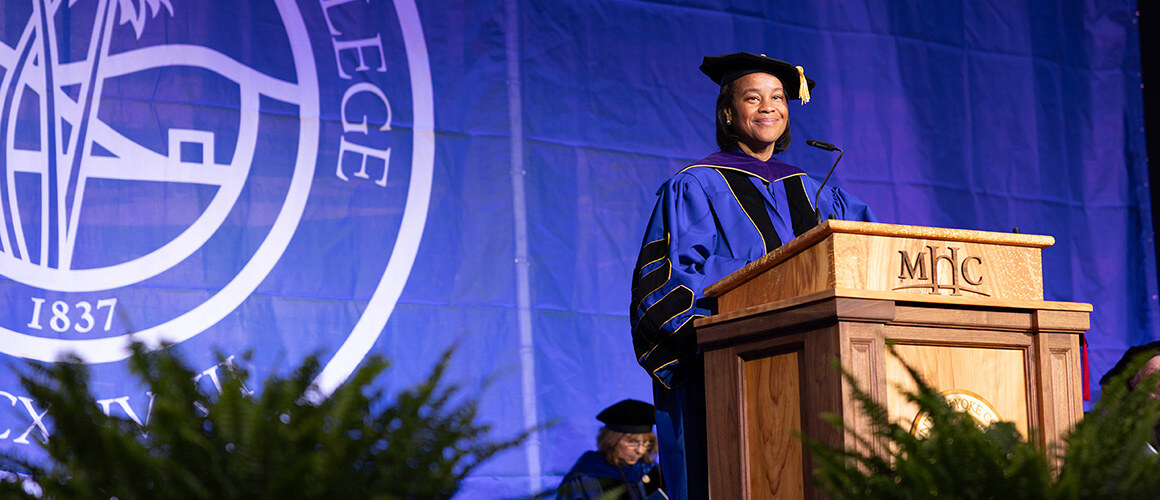
Mount Holyoke College celebrated the class of 2026 at its one hundred eighty-ninth Commencement and marked the occasion with remarks from trailblazing alums and speaker Beverly Guy Sheftall.
On Sunday, May 24, 2026, Mount Holyoke College held its one hundred eighty-ninth Commencement and celebrated the achievements of 556 undergraduates, 47 graduate students and five certificate holders. Due to rain, the ceremony was held indoors at the Field House in Kendall Sports & Dance Complex. Whether they attended in person, at viewing centers on campus or via livestream, families, friends, alums, faculty, staff and supporters were enthusiastic and excited.
The Laurel Parade
Before the Commencement ceremony, the Mount Holyoke community observed several traditions, including Canoe Sing, Berries and Bubbly, and the Baccalaureate ceremony. The final tradition before Commencement is the Laurel Parade, held this year on Saturday, May 23. The parade welcomed the class of 2026 into the Alum Association and celebrated alums returning to campus for Reunion.
The sound of bagpipes echoed throughout campus as marchers, wearing the traditional white outfits paired with alum scarves in their class colors, lined up by class year. Alums held signs that joked about their eras’ milestones and memories.
“We shortened our skirts by one inch every year!” said a sign held by a member of the class of 1966. A sign from 1986 proclaimed, “We had typewriters and smoking lounges!” “YouTube launched while we were at MHC!” a sign from the class of 2006 declared.
Students from the class of 2026, hoisting swags of laurel, expressed both joy and awe at taking part in the tradition.
“I’m mostly sleepy,” joked Maya Bywater ’26, a history and politics double major from Erie, Pennsylvania, as she waited for the parade to start. “They had us get up pretty early for this.”
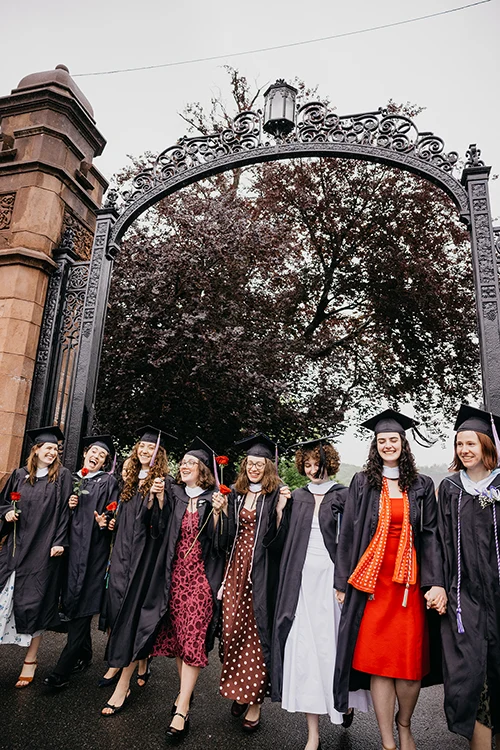
She added, “I’m excited. I think it’ll be fun. I’ve been hearing a lot of very welcoming things from the rest of the alums about how the Laurel Parade is when you join the alum network and you’re part of the community, so that’s very welcoming.”
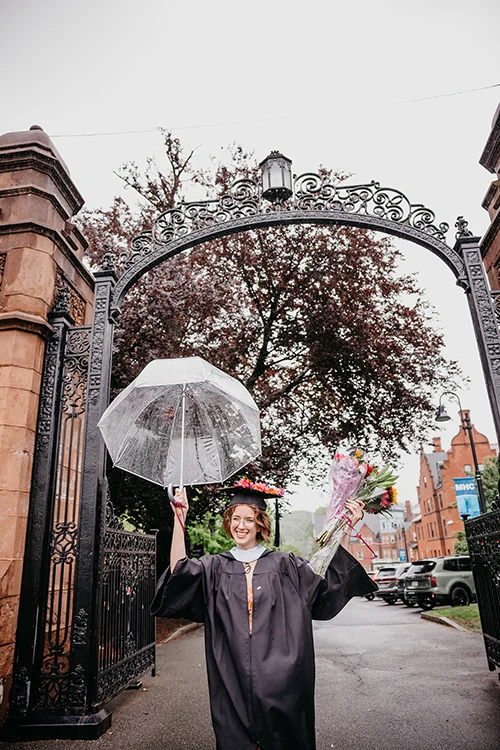
“During my sophomore year and junior year, I was working at Reunion, and I would see my friends graduating and walking in [the parade],” said Mehira Mim ’26, a graduating chemistry major from Bangladesh. “I was mentally prepared that I was going [to] be one of them one day — but now that I’m standing here, it hits different.”
“The day you’ve been waiting for”
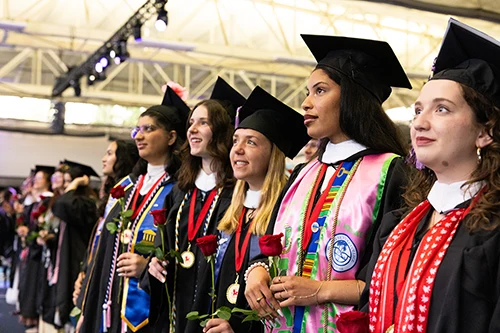
The Commencement ceremony took place the next day. Graduates wore traditional robes, but many of them also sported stoles, pins, honor cords and sashes. Many students chose to decorate their mortarboards with glittery red pegasi and purple phoenixes, DNA helixes, poetry, paper flowers, messages to parents and families, and shoutouts to the class of 2026.
Each speaker at Commencement touched on the process and promise of change. Sally Durdan ’81, chair of the Board of Trustees, first did so as she mentioned “Parable of the Sower,” this year’s Common Read selection. In the book, Octavia E. Butler wrote, “All that you touch, you Change. All that you Change, Changes you. The only lasting truth is Change.”
“Two emblems of change’s bittersweet nature stand before us on today’s stage,” Durdan said. “You may recall the summer of 2024 when lightning struck our beloved copper beech tree. When the arborist confirmed that it had to come down, our community was heartbroken.”
However, she continued, the legacy of the tree lives on: Two new lecterns were fashioned from the tree and were making their debut at this year’s Commencement. The podiums “will be part of welcoming new students at Convocation and bidding adieu at Commencement for generations to come,” Durdan said.
President Danielle R. Holley was next to address the graduating class.
“This is the day you’ve been waiting for,” she said. “The culmination of the work you’ve poured into earning your degree. The celebration of the person you have become within our gates.”
She also discussed growth and change. “What unites Mount Holyoke grads across both geographical borders and generations is the shared understanding that growth is a process. It’s never finished. And it happens by never ceasing to question. Now, poised to begin your next adventure, you may find yourself preoccupied by answers, or, more specifically, by a lack thereof. It’s true: none of us knows precisely what the future holds — particularly at this moment when the world seems to have gone mad. This can be nerve-wracking. My advice: don’t let impatience for the answer distract you from living the question.”
Student speaker Asmi Shrestha ’26 was the next speaker at the lectern, reflecting on the class of 2026’s journey. She remembered how she felt at her first Convocation four years ago: “It was solidarity. A clear, loud, unmistakable sense of solidarity.
“But solidarity is not a simple thing,” Shrestha continued. “It shifts. It grows. It gets complicated. Paths diverge. We change. We let go of some things and hold tighter to others. And I don’t think that is something to grieve; rather, it is proof that we grew.”
Two alum honorands also took up the theme of change. Visionary advocate, litigator and philanthropist Leslie Anne Miller ’73 accepted an honorary Doctor of Laws degree and told the graduates that they had to use their voices for change.
“Women, along with people who have been marginalized by virtue of gender, have made remarkable progress in the years since I graduated,” she said. “We made contributions to our communities, to our state and to the country. Our progress has been hard-fought and hard-won, but we know we’re still not where we need to be, and so we must continue to use our voice to resist efforts among leaders of government today who are attempting to roll back the decades of progress that we have made, who are questioning whether women belong in the workforce at all and [some] who … are asking whether we should have the right to vote.”
Maria Z. Mossaides ’73 was also granted an honorary Doctor of Laws for her four decades of achievement in government, including serving as the Child Advocate for Massachusetts since 2015. She invoked the legacy of another transformative Mount Holyoke alum.
“In the words of my North Star, Frances Perkins, I expect that you will all walk through those open doors of opportunity and do the best that you can to ensure that another individual is able to walk through that door,” Mossaides said. “Regardless of what position and where you’re going to land, I hope that you will look around and take care of another individual who’s going to need some help, just as you were held in your years at Mount Holyoke College.”
Beverly Guy Sheftall, trailblazing thought leader in Black feminist studies, writer, anthologist and founding director of the Women’s Research and Resource Center at Spelman College, also gave remarks.
“This is a particularly special day for me as I reflect upon my many years as an unapologetic feminist agitator,” she said. She noted that if someone had told her when she graduated from college in 1966, “that Mount Holyoke College would be giving me an honorary degree 60 years later — no one would believe this.”
Guy Sheftall spoke of the power of women’s colleges — not only Mount Holyoke but also her alma mater, Spelman College. “Women’s colleges educate women and those discriminated against on the basis of gender, including trans and nonbinary students,” she said. “[They have] helped to change the world in ways that are not the same for [all-gender] colleges.”
She also encouraged the class to draw on their inner resources when going out into a world that is both flawed and challenging. “You will need courage, flexibility, relentless purpose and joy.”
After these words from peers, administrators and honorands, the class of 2026 listened to the choir sing the “Alma Mater,” crossed the stage to receive their degrees and turned the tassels on their mortarboards to the right, ready to be changemakers.