
Understanding science in English and Spanish
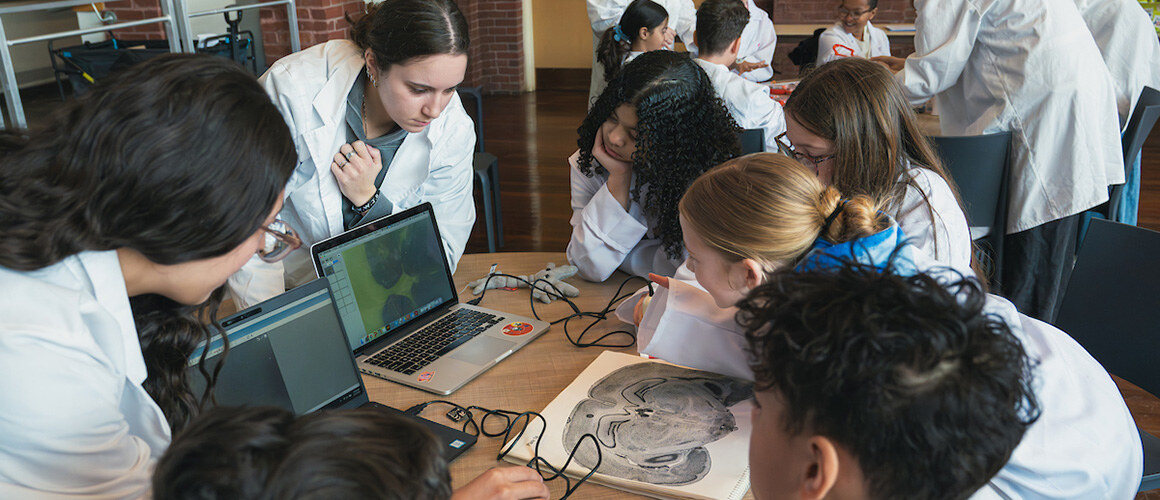
Cerebro 101 is an initiative led by Mount Holyoke College faculty Marta Sabariego and Nieves Romero-Díaz that teaches dual-language elementary students about neuroscience and behavior.
Scientists in white lab coats don’t usually high-five their colleagues during experiments. However, 39 fifth-grade students from Holyoke Public Schools (HPS) were doing just that as they took part in Cerebro 101, a bilingual neuroscience outreach initiative headed by Mount Holyoke College faculty Marta Sabariego, associate professor of neuroscience and behavior, and Nieves Romero-Díaz, professor of Spanish on the Alum Foundation.
At the beginning of the day-long workshop, fifth graders filed into the Great Room in Blanchard Hall. Romero-Díaz and Sabariego explained in Spanish what would happen that day. The students were split into two groups: one would tour the campus and the other would stay and conduct neuroscience experiments. After lunch in the Dining Hall, the two groups would switch places.
Cerebro 101 was inspired by Sabariego’s daughter, then a first-grade student in a dual-language program.
“She would talk about science, but she would always feel like everything was not in her maternal language,” Sabariego said. “Why [couldn’t she] access things in the language that she feels the most comfortable and safest?”
Sabariego did a one-off workshop with her daughter’s class but felt more could be done. Following that initial workshop, she expanded the effort by involving Mount Holyoke students, primarily from neuroscience and Spanish, to deliver a series of Cerebro 101 workshops for all first-, third- and fifth-grade students in the Holyoke Dual-Language Program at Kelly and E.N. White elementary schools. This phase of the project was supported by external funding from the Massachusetts Cultural Council and by alum Bessy Reyna ’70.
Building on this work, Sabariego partnered with Romero-Díaz to organize a more formal dual-language program at HPS. The program was funded through the Innovation Fund, a key initiative of the College’s strategic plan, MHC Forward, which supports interdisciplinary co-teaching.
“We [were] starting to see a path, a track, of students who were arriving [at] Mount Holyoke with the interest in neuroscience and Spanish, or [who were] native speakers [of] Spanish,” said Romero-Díaz. “We thought of different ways [to] offer students a different track to connect both.”
“This initiative … also [gives] paths for students to be able to do both humanities and neuroscience, because they should not be exclusive,” Sabariego said. “I think that having them together is exactly what liberal arts is about.”
The connection between MHC and the HPS dual-language program was facilitated by alum Laura Espinoza-Mufson ’10. She is the associate director of dual-language learning for HPS and was a Spanish language and literature major at the College.
“Nieves [Romero-Díaz] and I connected at an event at Holyoke Public Schools,” Espinoza-Mufson said. “She [told me] she [was applying for] this grant to do neuroscience workshops for kids in both English and Spanish, and I thought that would be a great opportunity for our dual-language kids. So we started brainstorming … what schools to go to, what grade levels, which schools would be the best fit.
“And so, in the fall, they came to Kelly School and did workshops with the second-grade students. The second piece of it was planning a field trip for the kids to come to the campus. We decided to do that with fifth graders, and it’s been an amazing experience. The kids love it. It’s interactive, it’s in both languages, and they get to experience science in a different way. It’s a topic that they don’t typically learn about in school, so it’s new and challenging for them.”
The Mount Holyoke students who lead the experiments and the tours are more than guides — they’re role models for the elementary students.
Regina Ortega-Damian ’27 is a neuroscience and behavior major from New Castle, Delaware, who took the fifth graders on a tour of the campus. “I’m excited to show them the campus, and inspire them to see people in college and doing big stuff, and being that role model,” she said. “Maybe that [will be a] little push to have them continue, even though they’re so little.”
The elementary school students who first stayed in the Great Room were given appropriately sized white lab coats. They gathered around four experiment stations, each one led by at least one Mount Holyoke student who explained what was happening in both English and Spanish.
Mount Holyoke students showed the fifth graders rat brain models and slides, as well as neurons in plushie form, and guided them through the rudiments of neuroprosthetics and neuroplasticity.
As Bad Bunny played in the background, the budding scientists started to get raucous. High-fives were traded. Cries of “Crazy, right?” “YEAH!” and “What’s next?” echoed throughout the room.
More than a field trip, Cerebro 101 empowers HPS students to speak about science in Spanish and shows them new possibilities for their futures.
“At the beginning [of the session], we asked them, ‘How many of you want to be neuroscientists?’” recalled Sabariego. “There’s one or two. At the end, we ask them again, and they only want to be neuroscientists, and so that’s very exciting.”


