
Widening my horizons in D.C.
Mount Holyoke College senior Myra Arif Zia ’26 took part in the Semester in D.C. program and learned key things about her career, her future plans and America at this moment in history.
Mount Holyoke College’s Semester in D.C. program is one that is meant to open students’ horizons to careers in public service, government and more. It is a program that allows students to live in the capital city and experience learning in classrooms, courtrooms, research centers and federal buildings. I knew I wanted to be part of the cohort that got selected to go to Washington D.C. the second I stepped into my American Politics class with Adam Hilton, the faculty director of the program. It was my honor then, in my junior year, to be one of the seven MHC individuals selected to take on the challenge of living and learning in Washington D.C.
Living in Washington D.C. was as if I was walking through history and watching it unfold in front of me. I remember walking into the Truman Bowling Alley, tucked under a wing of the White House, and bowling with MHC alums and students while looking at trophies and trinkets left by presidents of the past. I remember walking through the Belmont-Paul Women's Equality National Monument and wearing the coats and hats left by women of the suffrage movement as they marched on Washington D.C. in the early twentieth century. “I stand on the shoulders of women before me, ” I read as I thought about how grateful I am to be a student at Mount Holyoke College, a place that pushes me to have a voice and advocate loud and proud. It makes me think of Frances Perkins, a Mount Holyoke alum who was the first ever woman to preside over the Department of Labor.
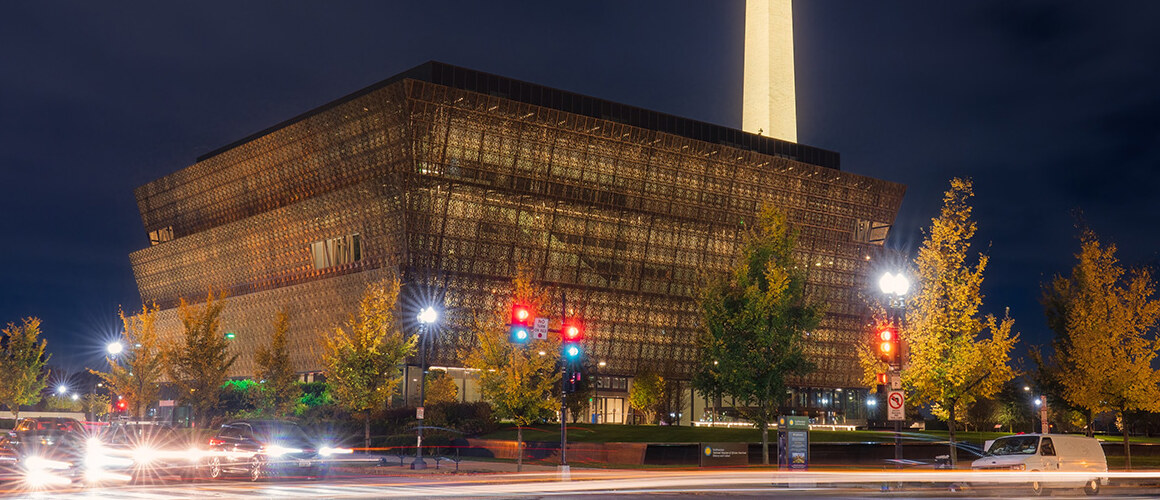
Advocacy is a big part of my identity, and living in Washington D.C. allowed me to explore how it looked in the past and what is required of it in the future. Washington D.C. is the epicenter of protests, dissent and discourse. It is where necessary conversations about civil rights, Jim Crow and slavery were brought up while visiting Smithsonian museums, such as the National Museum of African American History and Culture, and other museums like the American University Museum at Katzen Arts Center. Through conversations with the tour guides, curators and directors of these institutions, our classes expanded our lenses of the country and visually engaged with the injustices of the elite and the impact on ordinary people. My interest in museums comes from a place of anger and passion for the arts. I will never forget the conversations had in these spaces, which especially in the nation's capital, tend to be inherently political.
As part of my experiential learning at American University, I went to the Central Detention Facility and spoke to detainees on the path of reform. We spoke about how systemic injustice has impacted their life and their decisions, as well as art, culture, music and fiction. You realize in these moments how much you have in common with people from all walks of life. On the other hand, I walked through federal agencies as part of my internship at a branch of the Department of Justice, and I learned about the administrative sides of the gears of this country’s government law enforcement. I can confidently say that it is a side of federal work I would have otherwise never exposed myself to. I would have never learned about the internal structure of agencies and the various steps one has to climb to propose policy changes agency wide and externally. These agencies have operations in all kinds of career fields: in compliance and litigation; in antitrust; in anti-terrorism; in civil rights (and the changing interpretation of such phrases); and more. I am grateful to my internship, which exposed me to these various sides of federal government work.
I think Washington D.C. is where I grew the most as an individual. It was there that I polished my interpersonal skills by learning to talk to individuals from all around the country and from all over the world. It is tough to do, to make earnest, genuine connections with MHC alums, federal government officials and corporate executives, but it is necessary in the current moment. It is not called the city of “coffee chats” for no reason. I learned how to navigate in political spaces, especially with people I was not in agreement with. As someone with strong opinions on the United States’ role in human rights atrocities abroad, it was difficult to ignore the outside world. As one of the few South Asians in my classes and the program, I knew it was necessary to address conversations relating to people from my side of the world. Especially in Washington D.C., these are not conversations to be ignored — not when it is the literal place where some of the most important global political decisions are made.
It was enlightening, of course, oscillating between the different dichotomies of this city. This city, so incredibly transient with every administration that fills its halls, functions in a way like one big federal building. I watched the 2024 presidential election results pour in at Howard University, holding the hands of my fellow cohort members — which is putting it lightly, really, because I think of these particular MHC students like my long lost sisters — as we processed the incoming political moment. As a Muslim American whose family history lives between Islamabad, Pakistan and Queens, New York, I felt like my very existence was and is going to be political. Washington D.C. allowed me to see firsthand, in the epicenter of the political moment, what America means and where I stand within it.